
First and foremost, let me lay out some disclaimers on the above title… I am not writing for The Economist nor The Wall Street Journal, so this article will not cover any of your traditional financial investments whatsoever - contact your Certified Financial Planner for all of that! I am here representing the Certified Professional Horticulturists, hopefully providing some information on protecting your garden investments; fountains, birdbaths, planters, and of course your plants.
As we head into the frosty winter months, I am never quite certain what Mother Nature has in store for us. Over the decades humans have gotten much better at formulating forecasts well into the future, resulting in superior predictive weather models now in our modern times. But as you well know, this is never a 100% guarantee kind of thing - our friend Mother Nature does what she wants sometimes. Try this polar vortex on for size or enjoy that atmospheric river coming to a town near you, if you know what I mean. I am hearing that the plan for us is a milder winter at this point, perhaps even a bit drier as well. I cannot shake the feeling that we will still get a couple of colder weather intervals, as this seems to always be the case in our neck of the woods.
It is always important to watch the weather projections so that we can properly plan on preserving everything in the garden oasis. Two major times for me are always the first frost and the last frost… When do we need to protect things going into winter, and conversely when can we safely put plants out after the last frost in spring? In our climate these dates vary, so year to year us gardeners adjust, like we always do. Crossing our fingers and toes may help, you never know…
I will get into plant protection next week, but some of the other items gardeners invest their hard earned money into are fountains, statuary, garden art and pottery (although I might suggest all of this is garden art!). I will raise my hand and say that I have all of these, and I also resoundingly say that I have zero interest in purchasing these treasures again year after year. When I choose something to add to my garden, winter time is absolutely a factor – will it last outdoors or do I have to do something to overwinter it safely? I know many of you are like me and incorporate garden art and the like into your landscapes to liven them up. Certainly anything and everything can be brought into the shed or garage to protect it until spring, but if your garage is packed like mine is, what do we do if we leave these things out for the winter?
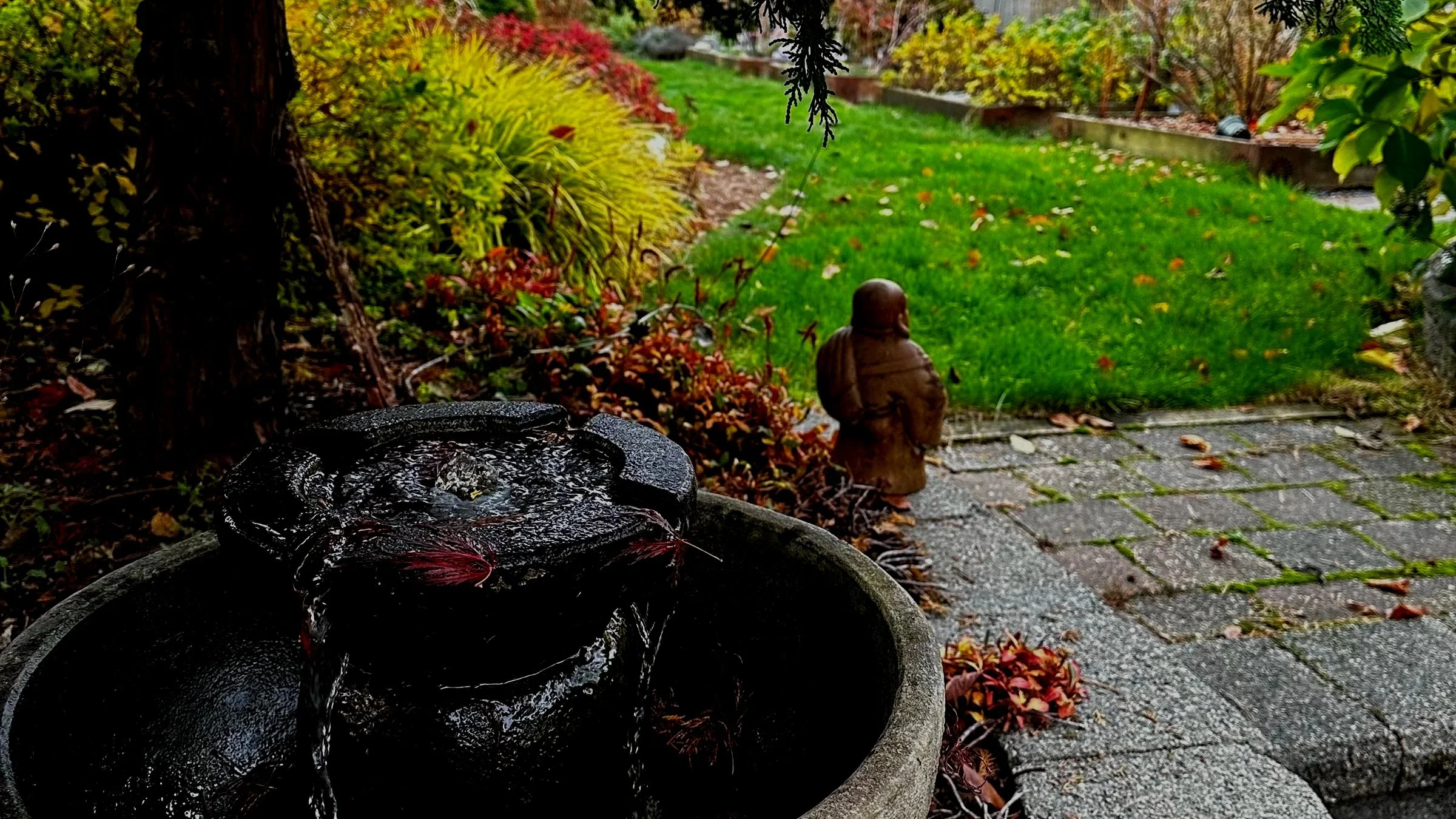
Fountains: This one is a no-brainer to me, ALWAYS winterize any outdoor fountain in our region. High quality cast stone fountains are made with essentially sidewalk concrete, but that does not mean that water will not seep into it, resulting in the potential of cracking or crumbling. As water freezes, it expands, allowing this to happen sometimes. As these are some of the more valuable investments in the garden, I would take the time in later fall (before hard freezes) to pull the plug and drain all fountains completely. Using a wet/dry vacuum may be easier than tipping it over, then cover it with a suitable outdoor cover for winter that keeps both rain and snow from collecting in it over the coming months. Quality covers can be found in multiple sizes with easy drawstring cords to get that cover on snug as a bug in a rug. Speaking for us at Sunnyside Nursery, we include the proper sized cover for free with every fountain we send home - investing hundreds of dollars in one and then not covering is not only asking for trouble and also voids any potential manufacturer warranty.
Birdbaths: I hope that many of you, like me, incorporate a number of birdbaths into your gardens to help our feathered friends and pollinators out a bit. These can be made from concrete so, just like the fountains above, I would simply tip the top onto its side or bring it into a dry area for the winter to avoid any chance of being full and then freezing and cracking. They can also be glazed like pots – another type I personally use to add some color into the landscape as well. Most of the time these are fine left out as is, but to ensure they are fine for spring I would suggest the same thing; tip the top onto its side, leaning on the base so that it is does not collect water over winter. It is important for birds to stay hydrated in the winter, so consider that when choosing one or taking them all down for the winter. That is why at my place concrete ones get winterized, the glazed ones stay to act as avian hydration stations.
Pottery: Overwintering is a major factor for addicts like me that have far too many pots all over the place, but it is has to do with planning and buying the right pots in the first place. We can access glazed pottery from many climes around the globe but Malaysia, China and Vietnam are the major importers. The firing process, thickness and quality of base material clay means everything. Malaysian pots are best indoors and will not fare as well outdoors in our region. Chinese clay is often fine, but I have also personally seen many crack and crumble here in colder winters. Sturdy frost-proof pots from Vietnam is the way to go in all honestly. These can be left outdoors with no worries whatsoever, with one exception… Pottery of all kinds will absorb and release moisture, so we just need to make sure the pot has adequate drain holes AND is not sitting on a surface that collects water, potentially making a small lake that freezes at the pot base causing damage. Styles like Terra Cotta have near zero chance of staying intact outdoors in cold winters, although sealing them will help a bit. Lightweight options like fiberglass and plastic should be fine.
Many of us have even more items made of other materials incorporated into our landscape. I love the glass art I have at home, and I am not worried about any of it outdoors whatsoever. The only glass items to protect would be those that collect water, in which case you should bring them in for the winter. Wood of all kinds is fine outdoors as well, it will continue to weather and patina over time. I don’t need to tell you that eventually it will rot years down the road, so again keep that in mind as you consider what should come in and stay dry. I would suggest that the cedar pot, trellis or obelisk is fine, but maybe the fancy windmill or wishing well might come in and stay dry if space allows you to do so. Resin or plastic is also a common material that sculptures, birdbaths and even fountains can be made of. These are safer outdoors all winter for sure, although again I would avoid leaving them to collect water and potentially freezing and cracking in extreme cold. Many of us utilize metals, which of course have no issues with cold but will continue to rust, adding a touch of rustic chic I for one enjoy.
I will continue our discussion on protecting your garden investments next week by talking some specifics on plants, since paying attention to what is planted here, there or in that pot can mean everything when we do get cold temps. To start with, I would recommend walking your outdoor spaces and noting things that may need protection, then make it an annual tradition in fall. Taking a few moments to assess potential dangers and then following these tips should save you from having to replace things like fountains, birdbaths and pottery come spring 2027. Don’t let Mother Nature dictate what you can or cannot have, protect your investments!
