
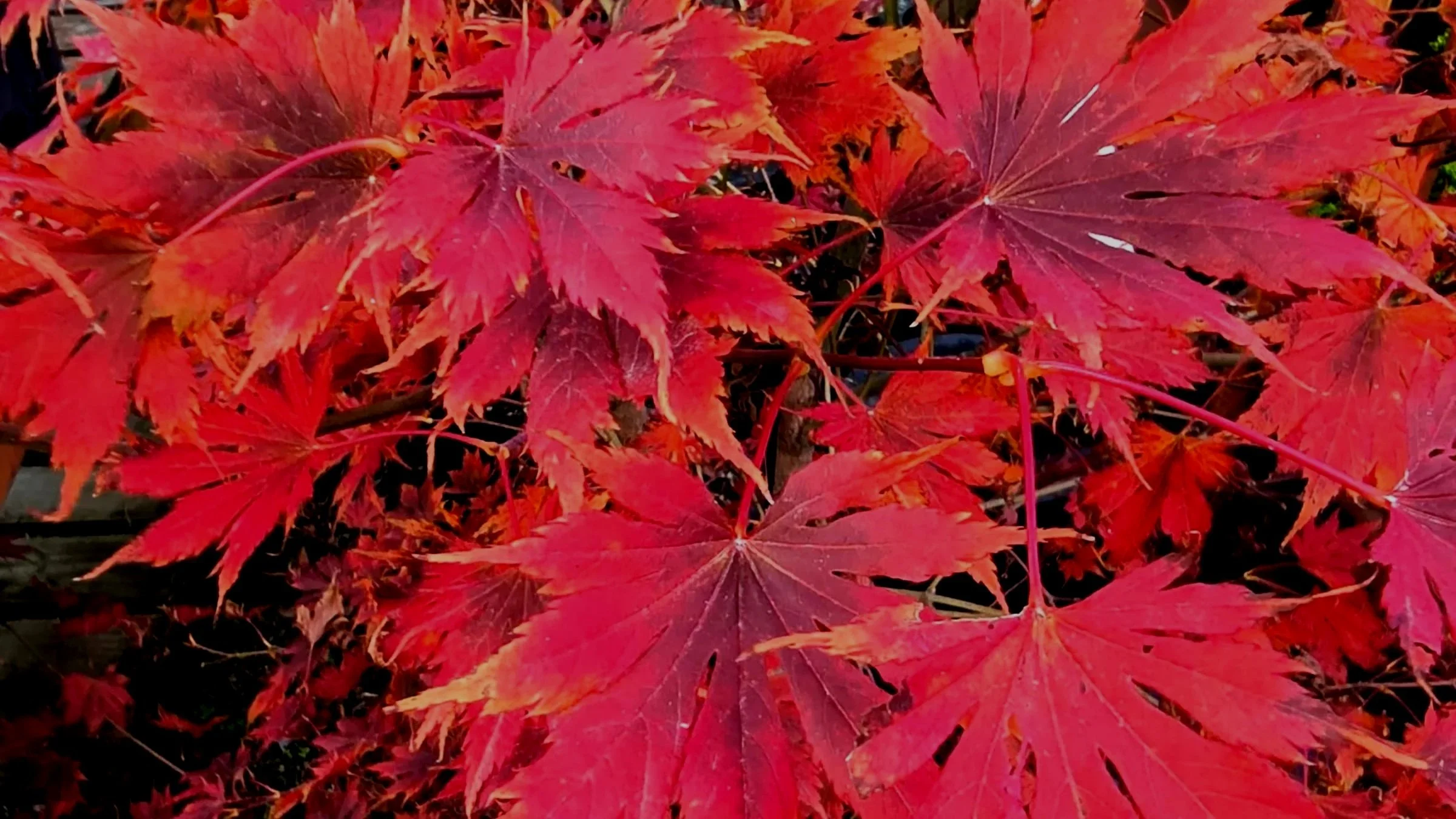
We are the midst of autumn, filled with the vibrant colorful tones Mother Nature has blessed us with. As I peek around the nursery and in my own garden oasis in Everett, I am amazed at the colors I see on many plants, including Japanese Maples. After a warm summer and somewhat dry fall so far, the fiery scarlets, outrageous oranges and golden yellows seem to be particularly stunning this year. I hope I speak for us all when I exclaim “Thank You!” to Mother Nature for providing wondrous plants for us all to enjoy.
In the world of Japanese Maples, the choices are seemingly endless, each offering a distinct foliage and color not only in fall but also in spring and summer as well. I always say that these are trees for all four seasons and that there is certainly a maple out there to catch any gardener’s fancy. Cultivars can be found to thrive in sunny or shady locales, large and small, both in ground and for containers. As a certified local plant enabler, it is always a pleasure to unite a gardener with the perfect Japanese Maple, smiling as I know that tree will provide decades of both color and structure for their garden.
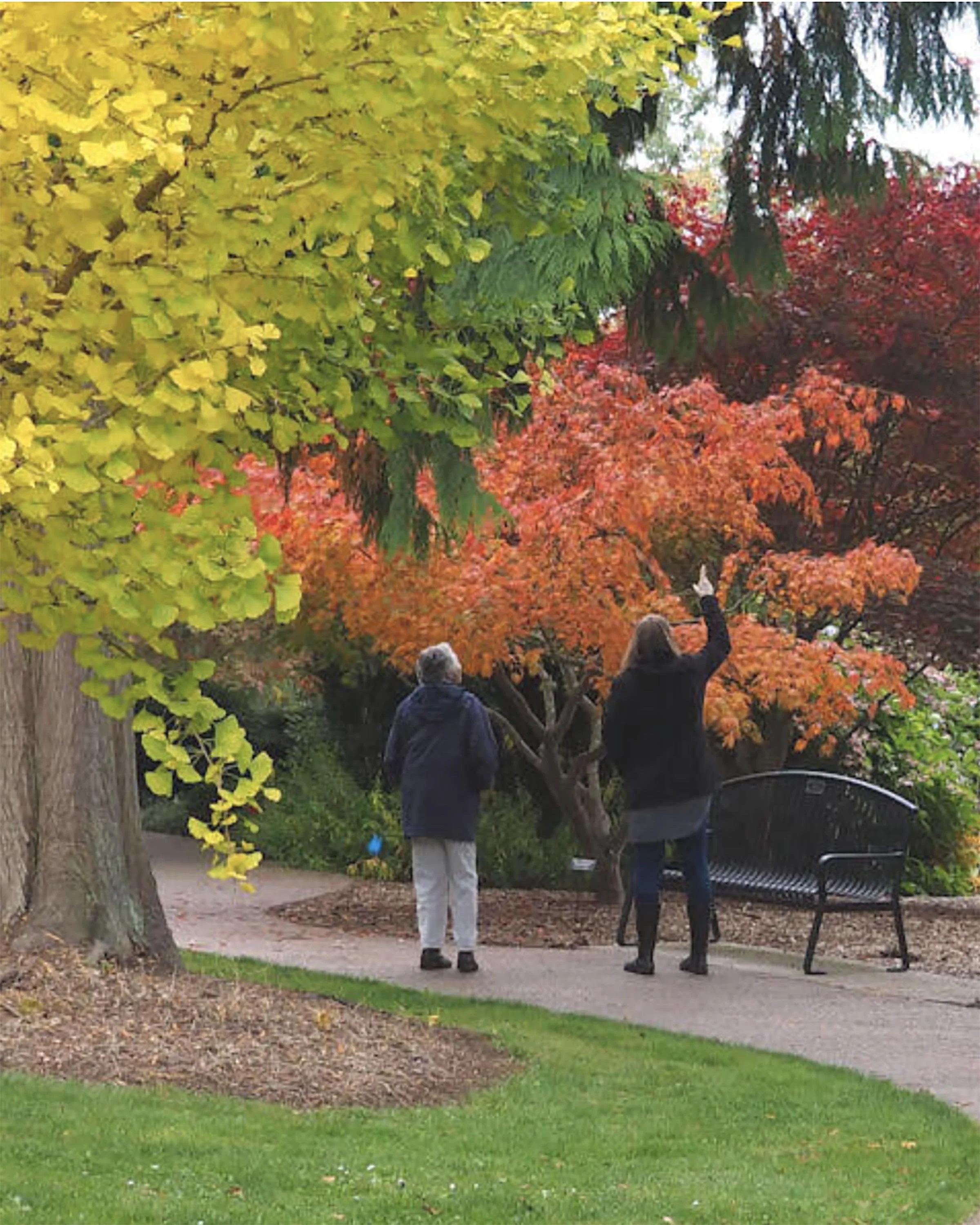
Now in all honesty, I have a problem when it comes to collecting these landscape beauties – not in a bad way, although my wife might disagree. For some reason more and more seem to find their way into my truck and subsequently into my garden. To me they are irresistible in every season, but in fall perhaps even more so. All of them will glow with color, allowing you to seek out red, orange, yellow or perhaps even a mixture of one or more.
Personally I am both happy and lucky to volunteer down at Evergreen Arboretum and Gardens, a lovely public Arboretum located at Legion Park in North Everett, as the curator of the maple grove. If you have not been there I would highly recommend a visit this fall, or anytime of the year for that matter, as there are botanical treasures and lovely outdoor sculptures everywhere. With Japanese Maples in particular there are some outstanding specimens, aged 20, 30 or even 40 years old, to marvel at. Many times we see smaller starter trees at local garden centers, but what does that tree look like down the road? At the Arboretum, not only do they glow in autumn but they are also more mature and will give visitors an idea of what shapes they will eventually become. If you want a couple to seek out, the ‘Omureyama’ along the path is stunning every fall, as are the two ginormous ‘Osakazuki’ specimens located on the Viewing Mound. The ‘Beni Komachi’, ‘Shindeshojo’, ‘Shigatatsu sawa’, ‘Autumn Moon’… I could go on and on. With some 85 types growing in the gardens, there is certainly one for everyone.
The world of Japanese Maples traces back centuries in (you guessed it!) Japan, its native habit. Their popularity has induced breeders all over the world to seek out and graft new and exciting variants, resulting in hundreds of distinct flavors to choose from. Some are even crossing species, to increase winter hardiness and mix up foliage options. Japanese Maples will always be Acer palmatum (or Acer palmatum dissectum for lace leaf types), but hybrids with Korean maple (Acer pseudosieboldianum) in particular offer vastly greater winter temperature hardiness. This has opened up some other areas of the country to the world of Japanese Maples, including our gardening friends in the colder parts of Eastern Washington.
Iseli Nursery is a world renowned grower of cool conifers and unique Japanese Maples right down in Oregon near Mount Hood. They are wholesale only but you can find specimens of superior quality grown by them at many local garden centers. If you love Maples, Conifers and other cool companion plants and want to geek out on a plant website, I dare you to escape theirs in less than an hour! After some 20 years of breeding, they have introduced two excellent trademarked groups of maples, the Pacific Rim Collection and the Jack Frost Collection. The outstanding members of both of these groups (crosses of A. palmatum and A. pseudosieboldianum) are exactly what I mentioned above, exhibiting the best qualities of both of the species. In the Evergreen Arboretum mentioned above, I have planted nearly all of the flavors of both over the years and continue to enjoy each and every one of them. This week we will delve into the Jack Frost Collection, then I will continue the maple mania next week with more tips and some descriptions on the Pacific Rim Collection.
‘Alpenglow’: This recent introduction glows with deep red spring foliage, maturing to bronzy-red in the heat of the summer, then finally blazing orange-red in the fall. A stately garden specimen with excellent branching for sun, maturing to about 20-feet tall and 15-feet wide.
‘Arctic Gold’: A brand new one for fellow yellow lovers, opening with chartreuse to yellow color in spring, glowing gold in summer and finally bright yellow to orange in autumn. This lovely grower is on the bushy side and will mature at 20-feet tall and 15-feet wide, but is best grown in shade as an understory tree or in morning sun at most.
‘Ice Dragon’: This is one of my personal favs as it looks like a lace leaf maple on steroids. This stunner leafs out with some orangey-red color, maturing to green with red tips in summer and finally a beautiful blend of yellow, orange and red in fall. The cascading habit and dissected foliage looks lace leaf for sure, but plants reach an impressive 10-feet tall and 15-feet wide over time. ‘Ice Dragon’ is a perfect specimen plant with great foliage, color, texture and lovely branching.
Other members of this series include ‘North Wind’ and ‘Arctic Jade’, both larger growing specimens (20-feet by 15-feet) with clean green foliage and simply stunning fall color of fiery orange to red. ‘North Wind’ leafs out red, then goes green. ‘Arctic Jade’ has a lovely cut leaf almost like the Peacock maple, Acer japonicum ‘Aconitifolium.’ For lace leaf lovers, the brand new variety is ‘Winter Queen’, a typical looking red lace leaf that offers atypical winter hardiness for colder climates.
I have never met a Japanese Maple that did not catch my eye, especially in the glorious season of autumn. A visit to the local garden center this time of year will show you many of these suggestions along with many other worthy traditional ones. Speak with a Certified Professional Horticulturist about your needs and allow them to show you some specimen options for that special spot in the landscape. I invite you to join me this Saturday, October 24th at 10 AM, for a free class on Japanese Maples at the nursery. We will discuss growing them, pruning them and emphasize some with outstanding fall color as well. Maples are truly amazing plants infused with bright color and bold character. Don’t forget to pause and marvel at the wonders of the season of all deciduous plants, especially the maples.
