
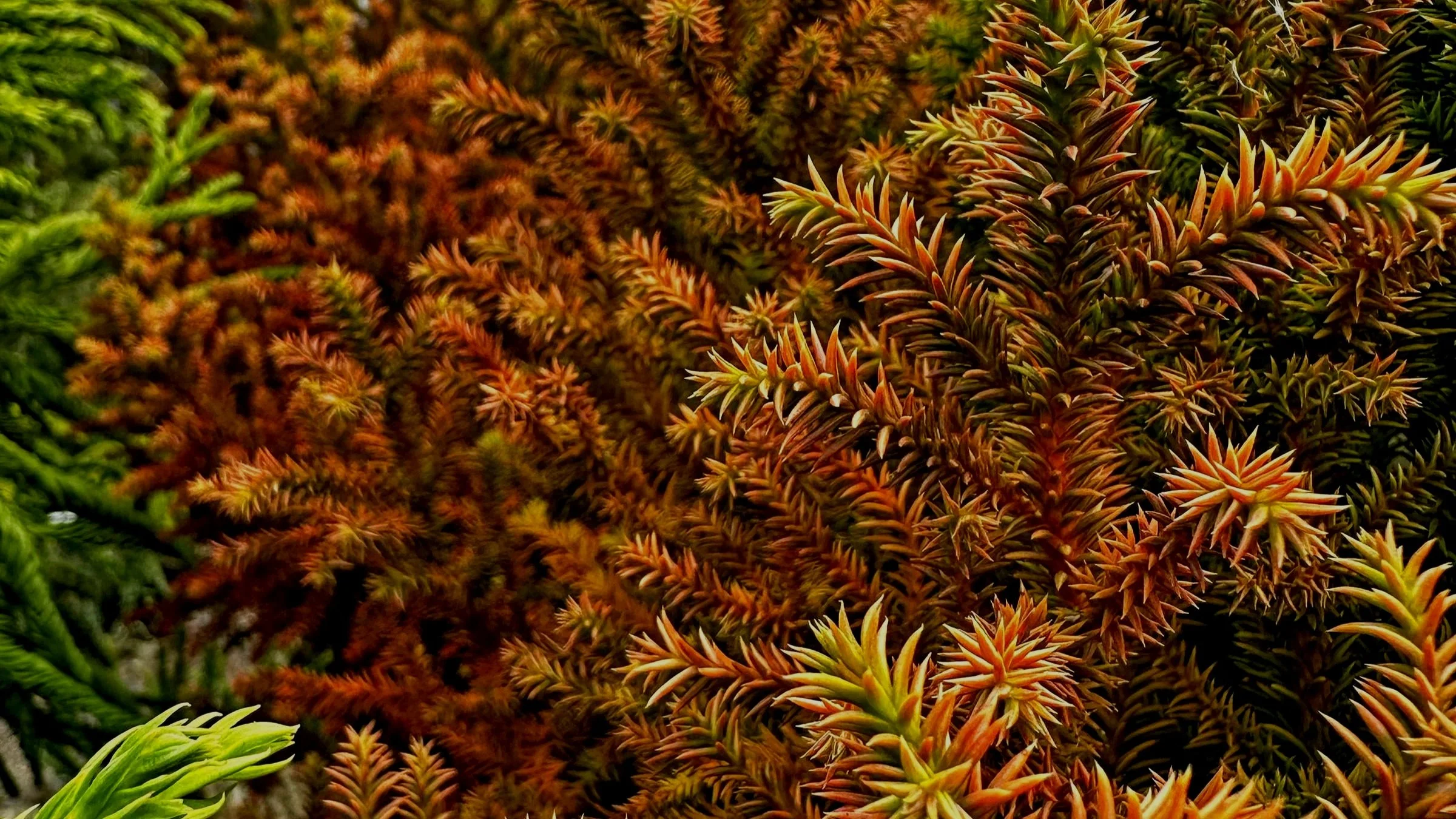
The silky sweetness of chocolate seems to be nearly universally adored by humans, especially as we near the sugary holiday of Halloween. Plants are of course loved by all as well, right? I am certainly not going to compare the two, although I might just have to nibble on the Take 5 bar stashed in my desk as I write this. For me, both are truly delectable as I cannot seem to ever have enough plants or chocolate. However, one is good for the waistline while the other perhaps not so much when in excess. I digress… I am truly going to talk plants (not confections) with an emphasis on those that turn wonderfully diverse colors for the winter, including chocolatey brown.
A few basics on growing conifers successfully always includes adequate sun for the vast majority and good drainage. Remember to explore the multitudes of cultivars available as this can dictate the size, shape and color of your specimen, both during the growing season and through winter dormancy. As you know I am always a HUGE proponent of the right plant in the right place, so selecting a dwarf, columnar or even miniature variety may be the way for you to go. Not only will this allow you to site it properly, it will allow the specimen to grow happily for years, never outgrowing its allotted space and eliminating the need for bad pruning.
In the past I have talked about conifers that are green, blue, yellow and everything in between. As we get into winter, any of these form the bones of the garden, adding not only texture and color but also the winter presence any garden requires. Once all of the perennials have gone dormant and the deciduous treasures have dropped their foliage for winter, what is left? Evergreen beauties, including conifers, to keep our eyes interested until spring.
There are some awfully cool and unique coniferous creatures out there to be found. Here are a few ideas worthy of consideration, not all of the coolest ones, but hopefully enough to get the juices flowing…
Japanese Cedars: Cryptomeria japonica is a wonderfully diverse specie of conifer and are a treasured gift from our friends in Japan. These offer unique awl or rope-like texture and produce a very different, yet stunning landscape plant. I bring them up as many will turn exquisite colors for the colder winter months. Miniature growers like ‘Tenzan’ glow with reddish-bronze color, dwarfs like ‘Tansu’ turn that chocolatey bronze color, or ‘Birodo’ will glow purplish-bronze tones. One dwarf I have growing, ‘Golden Promise’, is an absolutely stunning yellow in the winter in my garden. Perhaps the poster-child for winter color of any conifer is in this genus as well, Cryptomeria japonica ‘Elegans’, or what we call Plume Japanese Cedar. This is a large, stately grower with great texture year around and unbelievably intense chocolatey-red winter color. Many do not have the room for a ginormous grower like this so check out ‘Mushroom’, the useful dwarf shrubby form of this cool plant. There are many more I could pontificate on but just remember that Japanese Cedars offer uniquely textured foliage and great color, even in those grey days of winter.
Russian or Siberian Cypress or Juniper: I have heard this plant referred to as either one of these names, but Latin never lies and this is the plant deemed Microbiota decussata. As you can tell by the name, this an ultra-hardy conifer that is honestly just about bullet-proof. Microbiota makes a wonderful space eater, covering the ground with gracefully flowing limbs a bit like a Juniper, with the softer texture more like a Cypress. They are drought tolerant and can be grown in hot sun to even light shade. Proven Winners introduced a great flavor called ‘Celtic Pride’, perhaps a little tidier than the specie, but both are excellent. All of them turn a delicious chocolate-purple color for the winter. Even deer avoid them for goodness sake!
Western Red Cedars: We are blessed with the native Western Red Cedar, or Thuja plicata, which adds lovely bronze tip color to its green foliage over winter. This 40-foot monster is not for everyone, but lots of modern hybrids are out there for smaller locales. Flavors like ‘Tiny Tower’ and ‘Green Screen’ mature to half the size and are prunable even as hedges. There is even a dwarf shrubby form called ‘Gruene Kugel’, a very useful size at 3-feet tall and 4-feet wide. Gardeners can also take advantage of some lovely yellow variegated forms of these as well like ‘Ember Waves’ or ‘Forever Goldy’, both of which are close to a coppery-orange color in colder winter months. Being cultivars of our native they will all thrive, even in heavier soils, exhibit that lovely cedar fragrance and glow with the winter color that we all crave.
Junipers: Someday I will write something just on Junipers as this plant has gotten a bad rap over the years to some extent. “Juniper” is not a botanical swear word for goodness sake! They can be found in all sorts of shapes and sizes, including crisp green, bold yellow and bright blue. For our discussion today I want to emphasize winter color, particularly on Common Juniper, or Juniperus communis. These useful specimens can be upright or spread like ground covers, all with excellent drought tolerance and low maintenance requirements for those hot sunny locations. Common Juniper not only gets the cool little berries we make Gin from (thank you!) but also striking purple to chocolate winter color on many, including ‘Blueberry Delight’, ‘Berkshire Sparkler’ and ‘Pencil Point.’ Keep them high and dry and they are sure to give you years of easy garden performance.
To me it is simply wondrous that Mother Nature provides us with such diversity in the world of plants, in this case conifers, from similar climates across the globe. We have some excellent natives in our region, we are the proverbial “Evergreen State” after all, but other goodies from Europe, Asia and elsewhere add even more variation to our garden possibilities. Now that I have finished a couple Take 5 bars on our journey of coniferous winter color, I am still both craving more chocolate and of course more coniferous creatures.
I sincerely hope that you will not see “brown” as only a dead plant color but rather a lovely and subtle tone that should be mixed into the garden for additional winter interest. I will drop one last name, ‘Primo’ Arborvitae, a slow and bonsai worthy mini specimen with milk chocolate tip color in the winter. I have seen many a dead brown plant in my lifetime (trust me), but that is not the brown I am talking about! As we head towards frost and some winter weather, stop into your local garden center and gaze upon the glorious variations of conifer colors. Besides a multitude of healthy green shades, yellows and blues – there are some other useful options like chocolate brown, plum purple and bronze. The world of the conifers has much to offer, not only a variety of growth habits but also a wide array of unique textures and colors. Examine your landscape and find those locations where some winter “pop” is needed, whether big or small, and you are on your way towards an even more attractive year around garden full of interest in every season. And seriously, who can say “No!” to chocolate?
