Last week we began our journey in spring lawn rejuvenation, and as promised, I will continue down that lush green pathway this week. I mentioned controlling moss and weeds, applying lime as a pH adjuster and fertilizing with pure organic goodness. Now onto some more useful tips that will help you and your lawn become the envy of the neighborhood.
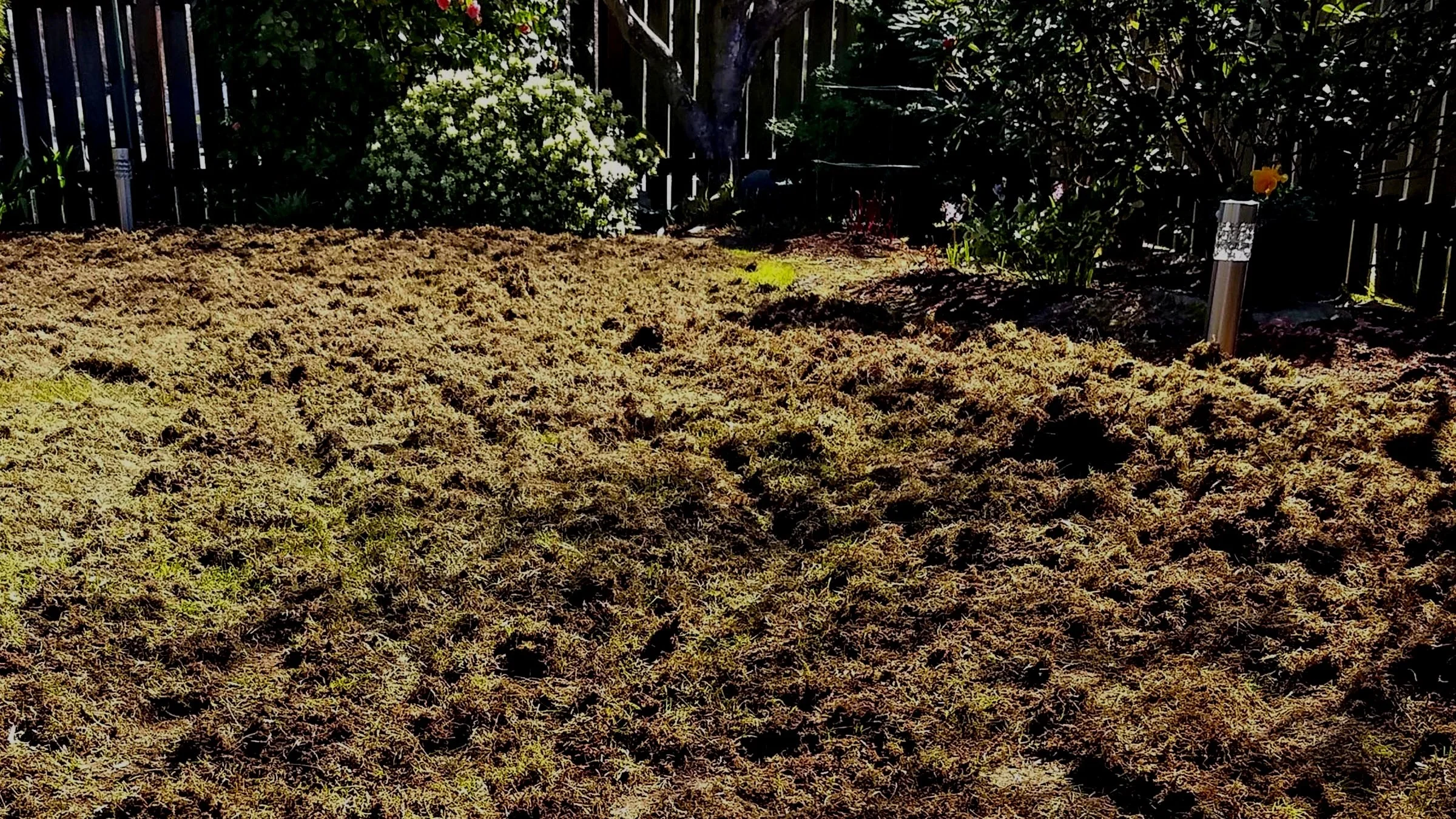
Once the weeds and moss are taken care of, it is decision time… To thatch or not to thatch, that is the next question. Thatching is a simple task done typically with a machine that removes all the weak grass and dead debris at the soil level, making room for brand new growth come springtime. This can also be done with a thatch rake, a sort of Conan the Barbarian looking weapon (if you like old Schwarzenegger movies you know what I mean) that provides a serious shoulder work out if you are up for it. Either way, thatching is the single best thing you can do for your lawn. The pile of debris that comes up will simply shock you, as will the dirty brown, dead-looking lawn that is left. Rake up all that light and fluffy junk and send it to the great compost heap in the sky. Then be patient – once these next steps are accomplished you will have a brand new lawn. When your spouse/partner comes outside and exclaims “What have you done to our lawn?!”, have them take a deep breath and be patient. Then in a month when everything has kicked in you can say “Told you so!”
Once the thatching process is complete and the debris is raked, a blank canvas for lawn remains, waiting for fresh seed. In the PNW, choosing the right seed is definitely important - most have the best luck with a fescue/ryegrass mix, some call it a sun/shade mix. I have always sworn by this for decades, although recently I discovered a wonderful blend called ‘PNW Black Beauty’ from an Oregon company called Jonathan Green. Their blend offers the same sun/shade flexibility but with a much deeper and extensive root system. If you have good soil it can root 18-inches deep or more! Drought tolerance is much improved with this mix and thus you will see significantly less water needed to keep your grass lush in our drier summers. I am on my third year using this mix as an over-seed and have been watering less than ever before. After two weeks of being gone last August I was shocked to see that it had not browned out at all. Perhaps using this mixture may help you (and your water bill) as well.
I think over-seeding is something many are familiar with, but it must all be lightly covered or “top-dressed” with a fine compost about 1/8 to 1/4-inch thick. If applied thicker, the seed is buried and will not grow, so just lightly toss it out, barely covering the seed. If you are up for some math, one 1.5 cubic foot bag should cover about 200 square feet of seed, while a 3 cubic foot bale would do about 400 square feet. Larger lawns may need compost by the yard, so think of one cubic yard as covering about 3,600 square feet of lawn. Those who skip this step are asking for a redo in my opinion. Birds will hop about and eat your seed for one, but more likely we will get a few dry days here and there allowing the seed to germinate but then crash without a buffer to keep it moist, which is key.
Do not use peat moss, please! Thirty years ago that is what we all did, but going back to last week, let’s see if you were paying attention… Peat is acidic, so what does that bring us? More moss and less turf! Peat is excellent at holding moisture for sure, but compost is the way to go. In particular I use a bagged compost from E.B. Stone Organics called ‘Top Coat’. It is pH neutral, does just as nicely as peat does holding moisture while also boosting soil structure and drainage over time. It is also super easy to see if you need to lightly water a newly seeded area. If you come home and it is dark brown to black, then there is plenty of moisture. But if you come home and it is lighter brown to tan, it may need a sprinkle. Again, never let fresh seed dry out, but also be careful not to flood it. A quick five minute shower will keep it moist, no need to pull out the fire hose.
I mentioned thatching above and thus I should also mention thatch diseases. Often for us locally, we inherit things like red thread, pink thread, snow mold and other fungal issues over our wet winter months. This may cause somewhat circular brown patches that increase in size and of course spread as we mow or walk on them. Spores blow in the wind and land in the turf, quickly germinating when it is wet and cool. Often the first dose of food in spring will encourage grass to grow right through and off you go, but this is yet another reason why I like thatching. When left, thatch festers diseases, so when we get it out of there we can truly start fresh. If turf needs to be sprayed to control diseases, go for something natural like a copper fungicide (what the golf courses will use) or an organic bio-fungicide like ‘Revitalize’ from Bonide. Neem Oil is also useful as a shield. Once turf is thatched, over-seeded and fed, off it goes without any thatch issues for the season.
One more topic that is prudent to discuss in this space as well is grubs. I mentioned circular brown patches with disease above, but larger irregular sections that go brown may be the result of either European Crane Fly larvae or European Chaffer Beetle larvae eating roots. Both of these creatures are most frustrating. In small numbers they are fine but large quantities means damage, and if left unchecked they can devastate a previously nice lawn. I have fought both and am currently battling the Chaffer Beetle some more. The real problem is the raccoons and crows that come in to literally tear up the turf in order to get these delicious grubs out. I would invite you to stop in to talk about either of these or thatch diseases, hopefully with good pictures or samples in hand. Try to get a clear, close up picture of the area so blades can be seen. You can also take a square shovel and carefully dig up a square chunk of lawn about 6 to 8-inches deep and lay it on its side. Dig through the soil a bit to see if you can find tan to greyish grubs in the soil to confirm that is the issue, then replace that section back in the lawn.
I am working on some natural ways to combat the grubs and will report results soon. There are chemical applications that will work for sure, but be careful with what you use along with the timing. Most often an early summer application will work best as adults are laying fresh eggs in June and July, the time when it is much easier to get the upper hand by eliminating the next generation kind of thing. As always, stop into your local garden center for help and to ask about options – Certified Professional Horticulturists are there to pose as wingmen in your battle.
Many of you are familiar with my OCD tendencies by now, and honestly with my grass it can reach a high level of absurdity sometimes. I am getting better, evidenced by the fact that I don’t go straight for the screwdriver each day when I get home to carefully pluck that one weed out. I also preach about going natural in the landscape and this is especially true with turf. Between my sons, pets and wildlife visitors (some could stay away, please!), I personally do not want chemicals of any kind on my green grass. Chemicals adhere to shoes, paws, feet… anything! Then we track them inside, or with pets they lick and ingest these harmful compounds. All good reasons to go natural and really consider what you are adding to your garden, especially in larger turf areas.
In modern times I understand that some people just don’t want a lawn, which is perfectly fine. But having said that, I am hoping it is not for the wrong reasons. Lawns have become the poster-child for chemical abuse and water waste, but I am telling you, and using my lawn as an example, that it does not have to be that way! Each of us will have our own tolerances for moss and weeds, so you do you. My hope is that you formulate a battle plan, grab some quality natural products and do your thing in March. With spring rains, it is the ideal time for the rejuvenation of turf. Spend a little time on these processes and the result will be a lovely natural lawn that you can both be proud of and comfortable with knowing that it is safe for all creatures great and small.