Everyone should want an attractive landscape, but achieving this can honestly be intimidating sometimes. However, remember that we are here to help! Every gardener I have met has favorite plants, colors, and/or textures that they may gravitate towards, and YOU should absolutely always make sure to do YOU, it is YOUR garden after all. However, try to keep in mind that a well-balanced landscape incorporates a variety of plants, including evergreen, deciduous and perennial specimens - fronds, grasses, bulbs, spikes and so much more! Your end goal should be to have a fabulous garden month after month all year long, not for just one or two seasons. We are most fortunate in our region to have a plethora of choices for suitable plants that shine in the various seasons of the year, including winter. Perhaps start by asking yourself “how do I want to use this space?”, and then we are able to get into the serious fun of plant gathering!
As you embark on your very own design journey, a few terms may help you visualize the way a professional designer would. Keep these terms in mind when you formulate your own battle plan as they may help you decide on the right plant, how many, and proper placement of your new companions. The right plant in the right place always leads to less maintenance down the road and giving plants the appropriate amount of space always leads to less pruning and a more natural growth habit. As you gaze upon the canvas of your own garden oasis, try to incorporate these thoughts into your own landscape design wherever you can.
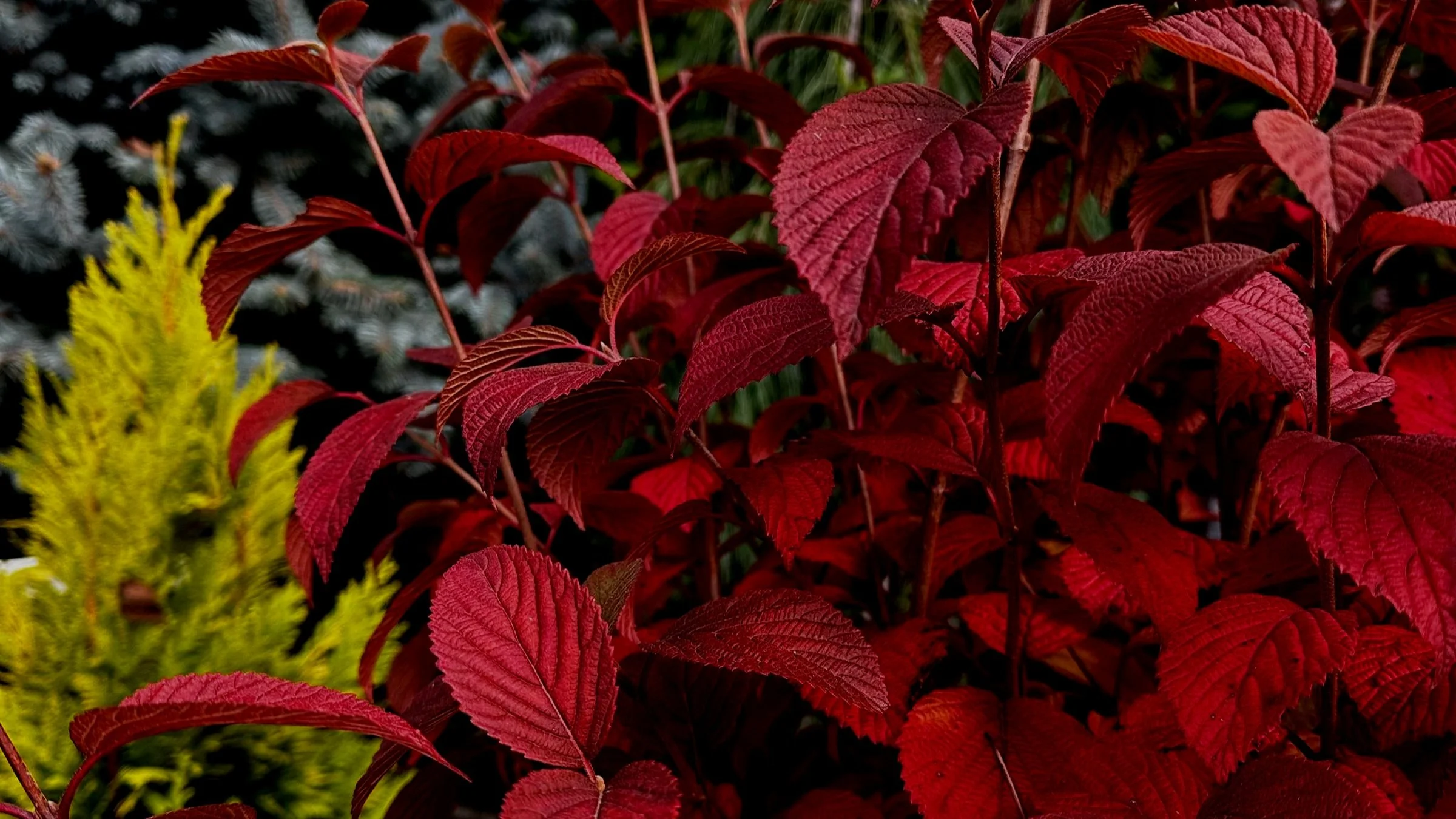
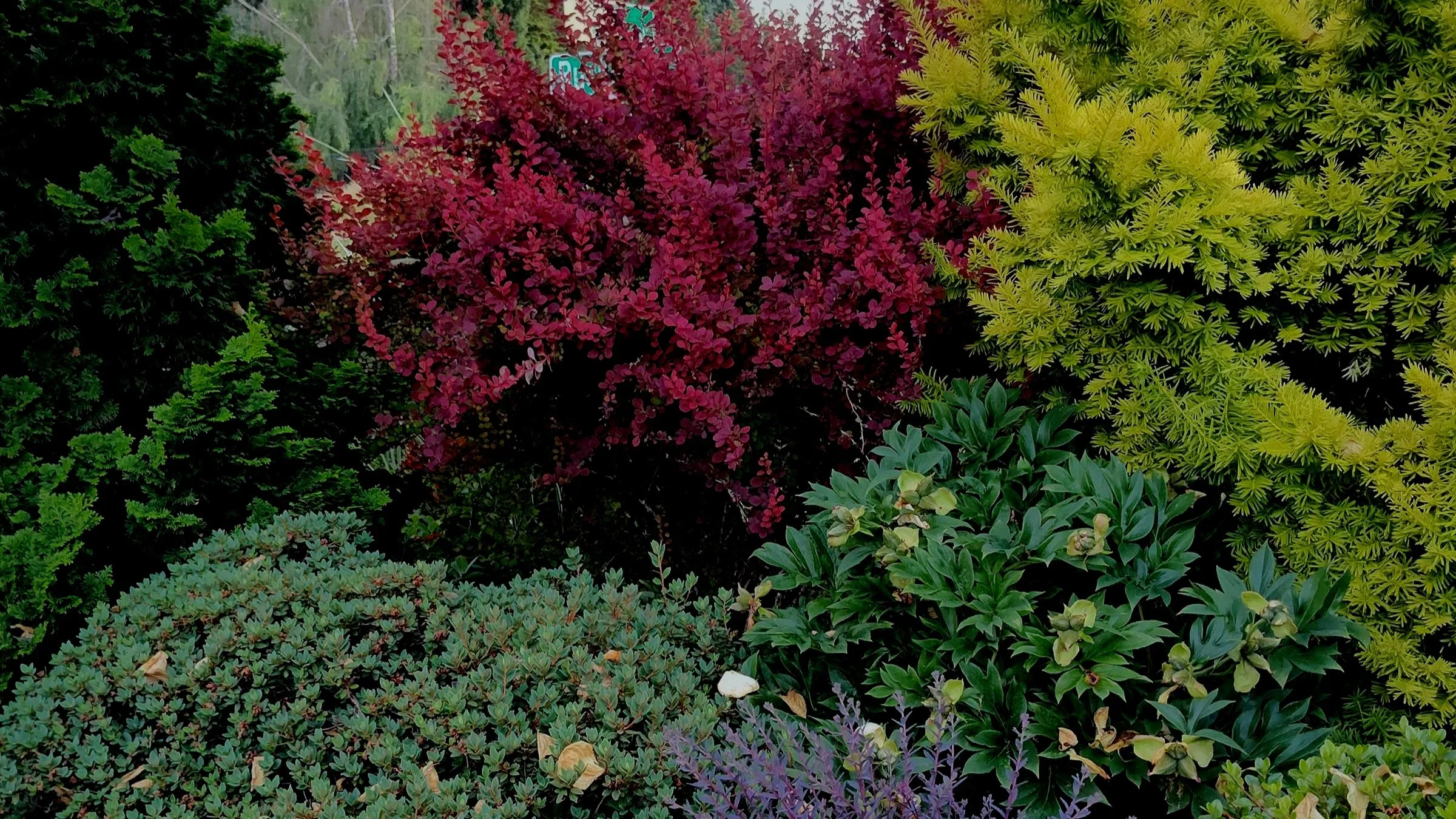
Color: This encompasses both flowers and foliage, and each and every one of us will have our favorites. I love yellow foliage while others may think it needs food. I would rather have bold oranges, reds and purples while others lean more towards soft pastels. No one is wrong here, we are all right. Keep in mind that flowers come and go but foliage remains, so try to think of “color” as not just flowers but utilize various foliage and variegation as well. A rainbow of options for both foliage and flower are out there for you to discover and use.
Contrast: Using contrasting colors and textures creates excitement in the garden. This can again be flowers or foliage, in either sun or shade. Big bold leaves mixed with smaller petite foliage or simple leaves against more complex pinnate-shaped foliage. With all of the greens we have in our yards, this makes it easy with yellows, blues, whites or anything variegated. In terms of flowers, this again can be color and/or size. Sometimes a big bold bloom makes a statement on its own, while other times a myriad of smaller ones can do the same trick. Mix up the color, in both bloom and leaf, and you have a visually stunning site to behold.
Foliage: Speaking of foliage, leaves come in all sorts of shapes and sizes, so take advantage of what Mother Nature has provided for us all! I am not trying to turn this into a botany lesson, but look up the various leaves out there and you will be stunned – it is frankly half a geometry lesson! There are some 40 distinct classified shapes like opposite, lobed, truncate, whorled, elliptic, pinnate, linear, rosette and palmate (Japanese maple – my fav!) just to name a few of them. One could get lost in foliage options when you consider all of the shapes, sizes and then colors as well. Combining the shape and size options that are the most appealing to you and don’t be afraid to go bold!
Layering: When considering a landscape bed, think of the simple set-up of layering. Short in front along the border, medium in the middle, and taller specimens towards the back. Gardens do not always have to follow this scheme, but it really does look nice AND maximizes sight lines, access, sunshine and air circulation. This also frankly helps create depth and results in a garden full of interesting sights no matter where you are.
Border Plants: These are low specimens that we would plant along the edge of the garden – think low and tidy. These can be low shrubs, perennials, annuals, bulbs, even ground-covers, anything that would eat up space and look nice. For me this is color, definitely some annuals but lots of summer blooming lower perennials (deciduous and evergreen) and grasses. Show your style and pick things you like, but also think of some of things above like color and contrast when making your final selections.
Foundation Plants: Perhaps we should call this the “bones” of the garden, the shrubs and smaller conifers that provide year around structure. I think originally this might have referred to the foundation of our houses, you know those 2, 3, 4-foot plants that would hide the base along outside walls. In reality, these tend to define a garden space, almost framing it like an individual room. I would incorporate both evergreen and deciduous plants into this mix, of varying heights, and even dwarf conifers. Again, see above and take advantage of size, color and varying shapes of foliage to catch the eye.
Focal Point: These are the true garden divas, the attention grabbers that jump out and say “Here I am!” A focal point can be a large shrub, a tree, or even a piece of garden art or statuary. These should contrast with the surrounding plants in color and/or size and really stand out from multiple angles. Sometimes one could be located at the end of a meandering path, while most of the time they are centrally planted towards the back of a bed. The foundation and border plants that surround this focal point ideally should work cohesively with the focal point, again utilizing contrast and color.
Masses/Swathes: Many of us plant enablers LOVE sending gardeners home with great plants and often folks want one of this and one of that kind of thing. It is your yard (and money!) so that is fine, but for impact you should consider masses or swathes of certain plants. I personally rarely plant one perennial, it is usually a group of three or more (odd numbers please!) that matures into one impressive mass of said plant. Perhaps along a border we do the same thing as a number of them planted makes more of statement. This can be as simple as a ground-cover, which not only eats up some space but keeps some of those pesky weeds at bay.
Repetition: One thing that I have tried to do my best at over the years is repetition. This does not necessarily mean the same things are planted over and over, but that colors can easily be carried throughout a garden – perhaps not with the same exact plant, but with varying cultivars of that plant or different plants that offer similar colors. Sometimes this is easy, other times not so much, but it is truly worth the effort. Perhaps you really like a certain plant, then use a few more over in a different bed as well. This brings continuity and some consistency to any landscape, while still maximizing variety and color.
Landscape design can sometimes be intimidating for sure, but again, there are experts available to help you! There are many excellent landscape designers in our area, folks to meet with and see if their vision matches yours. Perhaps you are a bit more DIY? Then do some plant searching at local garden centers and online. Speaking with a Certified Professional Horticulturist at the nursery can help as well – allow them to show you all the wonderful things we can grow in our region. I will certainly jump back to the various aspects of landscape design at some point, but in the meantime I am hoping that these simple vocabulary thoughts may help simplify the design process. I encourage you to dive right in, try some things and as I often say, make Martha (Stewart) proud!