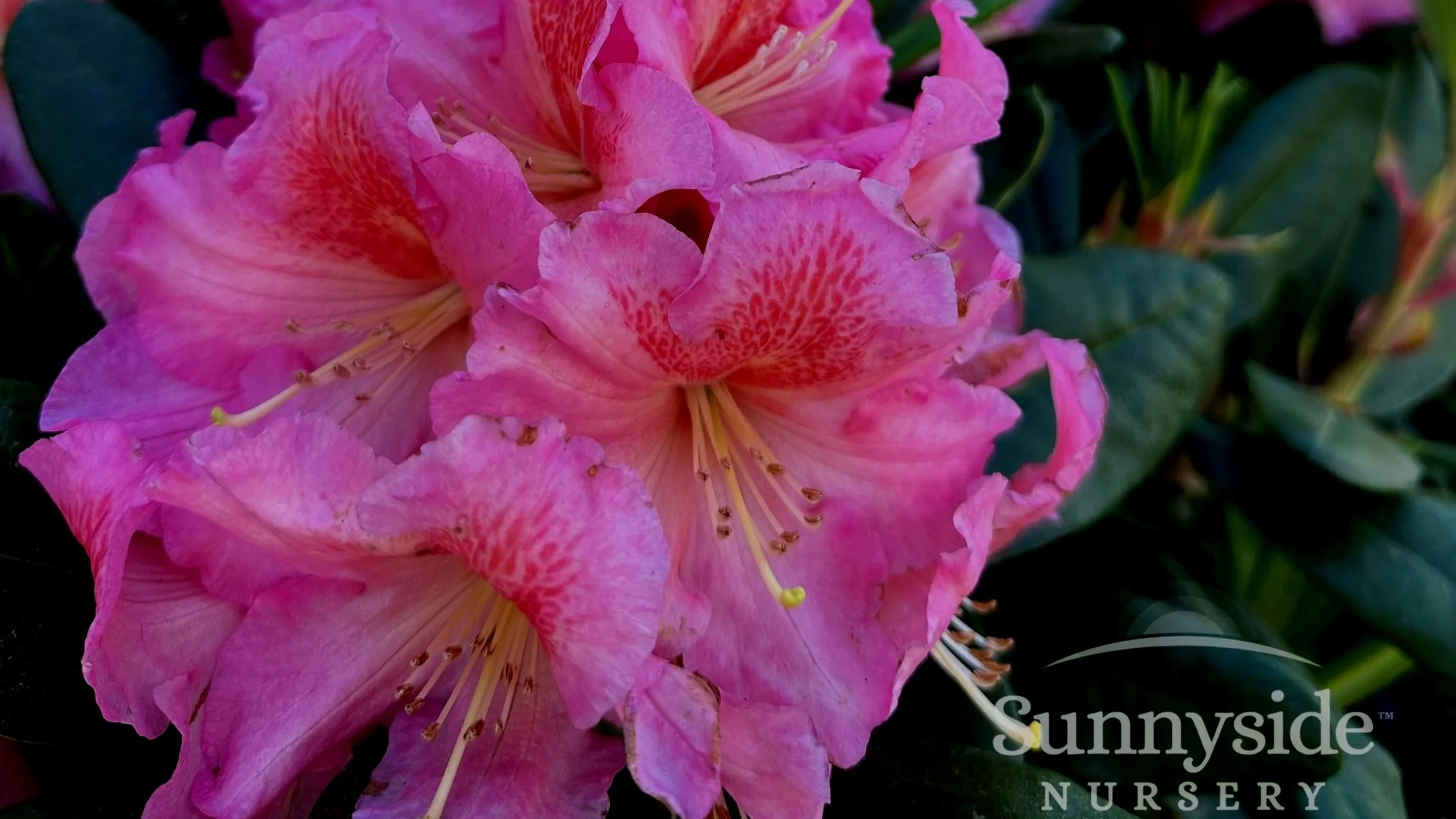
Rhododendrons are not only the state flower for our Washingtonian homeland, but they are perhaps the most widely planted shrub in our region. Now that we are in the heart of springtime in the PNW, Rhododendrons (and their cousins the Azaleas) are bursting into bloom all over. From home gardens to parks to commercial landscapes, the many flavors of Rhododendrons provide us some of the most reliably hardy spring shrub color around.
I write about Rhodies at some point each spring, but I am going to pivot a bit this year and focus on discussing a couple of insect issues. I see samples of these all too often at the garden center, each attacking plants and perplexing local gardeners. But first, please remember to recall the essential basics to growing Rhododendrons. As I have extolled many a time, a properly planted, fed and cared for plant is always going to offer superior resistance fending off or minimizing damage from both pests and diseases alike.
Now before I get into insects, I want to emphasize a couple points. First of all, none of these issues are the plague by any means and specimens can absolutely be treated. Secondly, I am glad we now avoid all systemics and neonics and can treat potential challenges naturally. Going green in the garden is paramount for preserving our pollinator friends and keeping our gardens safe for people, pets and wildlife.
The first insect I am going to tackle today is what we call a root weevil - an example of an insect I have seen in our area my entire gardening life. These pests live in our soil as larvae, then mature into adults that climb up stems each evening to have a late night snack before returning to the ground prior to the sun coming up. They are pretty cool, but what is not cool are all the little notches they cut into foliage. These bite marks on the edges of foliage (never the center) is the tell-tale sign that root weevils are in your soil. If you see this damage on Rhodies (or many other broadleaved evergreen plants for that matter) treatment can help eliminate them. It is tough to contact-spray weevils in all honesty, unless perhaps a midnight excursion with a flashlight and sprayer in hand is in the cards. It is much easier to either treat the soil or try to trap them. Using a granular product called ‘Eight’ (which contains chemical bifenthrin) can be sprinkled on the soil surface under the plant, then watered in thoroughly. You want this to get into the soil, so even doing it when it rains is best. This is a non-systemic chemical application and once into the soil will prevent pets, kids and wildlife from touching the granules.
Root weevils are beginning to wake up with the soil temps rising, so getting this down early is crucial to eliminating the population before they go into reproductive mode. If you are adverse to any chemical use, as I am, the other option is to attack them organically. Nematodes are little beneficial predators that can be purchased to inoculate the soil. These take time to grow and reproduce, so be patient. Most root weevil damage from adults occurs in later spring to summer, while larvae feed on the roots. Getting nematodes down early will help and as populations mature they will do a better job controlling larvae, which means less and less adults. Another method is to utilize sticky traps to catch them. Sometimes a product like ‘Tanglefoot' can be used at the base of a plant to literally trap them, offering another natural solution as well. Choose whichever route you are comfortable with and then have at those pesky weevils!
The other insect I want to mention is lace bug, one that has really become more prominent in our local landscapes in the last few years. These can do some serious damage in a short amount of time and will infect Rhodies, Azaleas and often Pieris as well. This is one I see around everywhere these days, even creeping into a couple of places in my own landscape oasis. Like with the root weevil above (and pretty much any critter), one key is to understand the life cycle. Adult lace bugs lay eggs underneath the leaves, which mature into larvae that begin the feeding cycle. They mature into adults with developed wings, then mate, fly to another plant and the cycle begins again. If left unchecked these can devastate a plant, and continue on, causing complete defoliation on all the old leaves and leave nothing but the new growth. I am a little worried this year in particular about lace bug as our lack of winter allowed almost all stages to overwinter easily, giving them a head start for the 2026 feeding season.
The damage you see from lace bugs is pretty noticeable, but please inspect your plants early and often. You will find little black spots and/or larvae on the undersides. Infected foliage will look strange - stippled and yellowing. Sometimes pulling some of the worst leaves off may help, and certainly cleaning up those that drop off the plant is important as well. As far as treatment options, two natural products are very effective if used correctly and multiple times. Since lace bugs are essentially hiding under the leaves, either spray must be applied thoroughly, covering the entire leaf surface top and bottom. I would choose an organic called ‘Spinosad’ myself, packaged in a useful natural spray from Bonide called ‘Captain Jack’s Deadbug Brew’. Spraying this three times roughly 10 to 14 days apart should catch all of them in all their stages and thus halt the progression of damage. Another organic product ‘Neem Oil’ would do the same as well. I might also suggest applying ‘Neem Oil’ once in the fall as a protection, ensuring no larvae are hanging out for winter. I have found this practice in my yard helps get a head start on the following spring. Perhaps also consider beneficial insects, as ladybugs also do a pretty good job at finding the larvae.
I will end with a request… please ask for help, just as I do on occasion. When issues with bugs (or diseases) arise, getting a proper diagnosis is essential. This way a suitable treatment battle plan can be formulated and success achieved. Sometimes issues are simply cultural, while other times it is a particular insect or pathogen causing the plant stress. Allowing your local garden center and Certified Professional Horticulturists on staff to help is the way to go. That is what we are here for! Take some close-up pictures on that fancy phone or grab some samples and get to the garden center for assistance. That way your problem can be confirmed, treatments discussed and your specimen will be on the road to recovery as soon as possible.
I would also invite you to attend our Rhododendron festival this Saturday at the nursery as well. We are privileged to have the local Pilchuck Chapter of the American Rhododendron Society as our guests from 10am to 2pm. They set up a wonderful truss show, displaying both unusual varieties and more common flowers for folks to admire. Stop in for a visit, support the Chapter and allow them to share some Rhododendron knowledge with you. In the meantime, I wish you all a happy hunting season of both root weevils and lace bugs!